
Summary
Every cute photo, school post, and "running late!" update you share is a puzzle piece. Here's how strangers use sharenting to build a detailed picture of your family - and how to stop it.
You’re not just sharing cute photos. You’re building a roadmap.
If you’re a parent on social media, this post is for you.
Not because you’ve done anything wrong.
Not because you’re careless or naive.
But because nobody has ever sat you down and shown you what your innocent, loving posts look like to someone with bad intentions.
That’s what we’re doing today.
What is sharenting?
Sharenting is the term for what happens when parents share – often enthusiastically and with the purest of intentions – details about their children’s lives on social media.
First day of school photos. Soccer game highlights. Report card celebrations. Funny things the kids said. Bedtime routines. Bus stop mishaps.
None of it feels dangerous. All of it is normal. Most of it is genuinely sweet.
But here’s what most parents don’t realize: each post is a puzzle piece. And someone who wants to see the full picture has all the time in the world to put it together.
The puzzle – let’s build it together
Imagine a parent – let’s call her Sarah – who loves sharing her family’s life on Facebook. Her profile is set to Public because she likes connecting with other parents in her community. She posts regularly. Nothing inappropriate. Nothing that would raise an eyebrow.
Here’s what Sarah posted over the last few months:
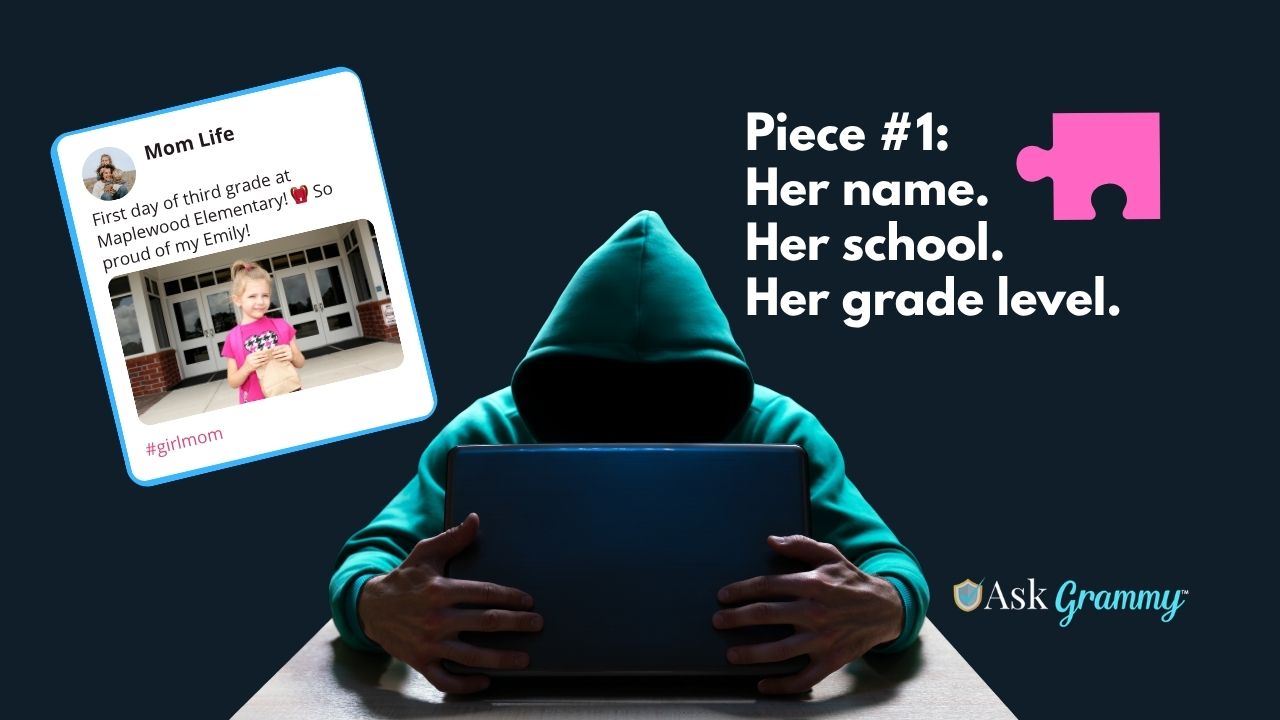
Post 1: “First day of third grade at Maplewood Elementary! So proud of my girl Emma! 🎒”
A stranger now knows: Emma’s name, her school, and her grade level.
Post 2: “Saturday soccer mom life! ⚽ Go Maplewood Tigers! Emma scored her first goal!”
A stranger now knows: Emma plays soccer on weekends. The team name – which narrows down which park or field she plays at. Her Saturday schedule.
Post 3: “Report card day! Emma is killing it in third grade – so proud! 📚”
A photo of the report card with the school letterhead clearly visible.
A stranger now knows: The school name confirmed again. The teacher’s name. Emma’s academic performance – useful for building rapport.
Post 4: “Running 10 minutes late to pick up the kids – traffic is brutal today! 😅”
A stranger now knows: What time school gets out. That Emma is sometimes waiting alone. That this happens regularly enough to post about.
Post 5: “Has anyone else had a strange man stop to talk to their kids at the bus stop? Mine were alone this morning and it really shook me.”
A stranger now knows: Emma and her siblings go to the bus stop alone. Every morning.
Now put those five pieces together.
A stranger – someone Sarah has never met – now knows Emma’s full name, her school, her grade, her teacher’s name, what she looks like, where she plays on weekends, what time school gets out, that she sometimes waits alone for pickup, and that she’s at the bus stop by herself every morning.
Sarah never gave any of this to a stranger. She gave it to her friends and family.
But her profile was set to Public.
This isn’t just a stranger danger story
It’s important to say this clearly: the vast majority of people who see these posts are exactly who Sarah thinks they are – friends, family, neighbors, other parents.
But it only takes one.
And the research backs this up. Publicly visible photos can be misused by individuals with malicious intentions – they can create fake images using AI or clone voices from videos for scams.
The FBI has warned that child predators use social media specifically because it gives them access to detailed information about children’s routines, appearances, and locations – without ever having to approach a child in person first.
Children may be exposed to a variety of risks as a result of sharenting, including identity theft, sexual exploitation, and possible emotional distress in the future due to the public sharing of their feelings and experiences.
And in a verified case reported by Mercury Insurance, a family who documented their vacation to Cancun on social media – posting before they left and throughout their trip – returned home to find thieves had broken in and stolen nearly $200,000 worth of property, including a Mercedes-Benz. The thieves knew exactly what to look for because it had all been posted online.
It’s not just children at risk
Sharenting is where this conversation starts – but oversharing puts people of every age at risk.
Vacation photos tell burglars your house is empty.
“Home alone tonight!” posts signal vulnerability.
New car or new purchase posts tell thieves exactly what you have worth taking.
Daily routine posts – off to work, picking up the kids, heading to the gym – make your schedule completely predictable to anyone paying attention.
Every post is a puzzle piece. Your puzzle. Your family’s puzzle. 🧩
The good news
You don’t have to stop sharing. You just have to share smarter.
Here’s what Grammy recommends:
Lock down your profile. Set your Facebook profile to Friends only – not Public. This single change dramatically reduces who can see your posts. Go to Settings → Privacy → Who can see your future posts.
Never post your child’s school name. Not in the caption, not visible on their uniform, not on the report card. Blur it or crop it before you post.
Skip the location tag. Especially for places your children are regularly – schools, parks, sports fields, bus stops.
Wait until you’re home to post vacation photos. Enjoy the trip. Share it when you’re safely back.
Rethink routine posts. “Picking up the kids!” and “Home alone tonight!” feel casual. To the wrong person they’re an invitation.
Check your profile picture. Refrain from using children’s photos as public profile pictures, as anyone with access to the account can see and misuse them.
Think before you post: What does this tell a stranger about my family? If the answer makes you uncomfortable – trust that instinct.
A note on dignity
If you’re reading this and feeling a wave of panic about posts you’ve already made – be kind to yourself.
You were sharing love. You were celebrating your kids. You were connecting with your community. There is nothing wrong with any of that.
You didn’t have this information before. Now you do.
That’s all this is. Not a reason for shame – a reason to make one or two small changes going forward.
One more resource for you
If this post got you thinking about your broader digital footprint – not just what you share about your kids, but what’s already out there about you – Grammy has a free printable checklist that walks you through exactly what to do about it.
No sign-up required. Just download, print, and work through it at your own pace.
👉 Grab the Free Digital Footprint Checklist at AskGrammy.com/free-downloads
Share this with a parent you care about
If this post opened your eyes even a little – imagine what it could do for someone who’s never thought about this at all.
Share it. Text it. Post it.
Because the parents who need this most are the ones who have no idea they need it.
– Grammy 🛡️
About this post
This post is based on Grammy’s research into social media safety, child protection, and digital privacy. All statistics and case references are sourced from verified organizations including the FBI, Mercury Insurance, the University of Alabama at Birmingham, and peer-reviewed research. Grammy receives no compensation for any tools or resources mentioned.