
Summary
AI-generated influencers are becoming more common—and sometimes, they’re not clearly labeled. In this post, I’ll show you how one account raised red flags, how people are being drawn in, and what to watch for before you trust what you see online.
People are falling in love with this influencer.
Some are even paying money to see more of her.
There’s just one problem.
She may not actually exist.
Why This One Caught My Attention
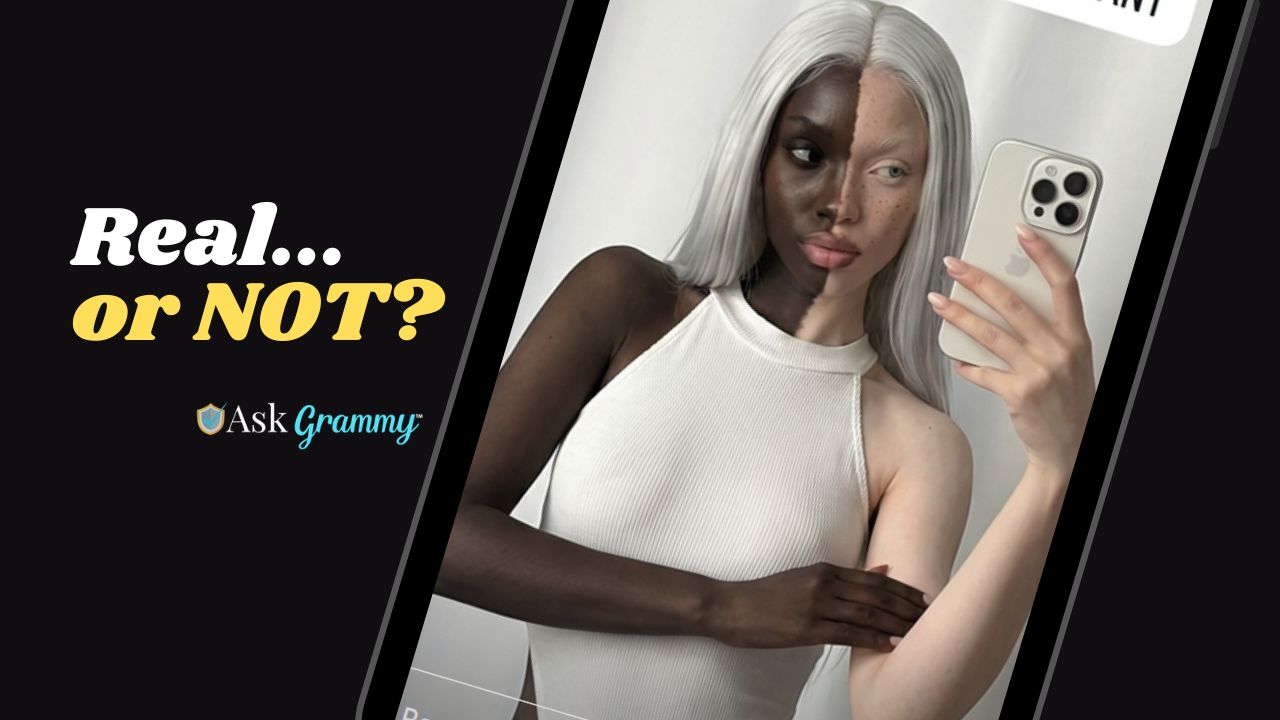
There’s an account making the rounds featuring a woman with a striking appearance – her face and body split into two distinct tones, one dark and one light, with different-colored eyes.
It’s visually stunning. And at first glance, it’s easy to believe you’re looking at a real person with a rare condition.
In fact, many commenters believe exactly that:
- “You are a gorgeous woman!”
- “Do you feel like two different people?”
- “People are pretending to be you on Facebook…”
These are thoughtful, well-meaning comments from people who genuinely believe they’re interacting with a real human being.
And that’s what makes this so interesting.
What Doesn’t Quite Add Up
When you take a closer look, a few things start to feel… off.
In some images, the dividing line between the two skin tones is perfectly straight—almost like it was drawn with a ruler.
In others, it’s jagged.
And in others, it shifts entirely.
Real skin doesn’t behave that way.
There are also posts suggesting this is an “evolution of childhood vitiligo,” supported by images of a young girl meant to represent the same person.
But here’s the problem:
Real Vitiligo doesn’t present as a perfectly symmetrical split down the middle of the body – and it doesn’t change patterns from one day to the next.
When a condition suddenly looks too precise… too consistent… or too dramatic to be human, it’s worth taking a closer look.
Because what you may be seeing isn’t a medical journey…
but a carefully constructed backstory designed to make something artificial feel real.
When Curiosity Turns Into Payment
Here’s where things take an important turn.
This account also links to a Telegram channel where followers can pay to see more “exclusive” images.
The content is partially covered…
and viewers pay to have those covers removed.
In this case, it’s a microtransaction system – roughly a few dollars per image.
Which means this isn’t just about curiosity anymore.
People are now spending real money…
to interact with someone who may not even exist.
The Bigger Picture
This isn’t just about one account.
We’re starting to see more and more AI-generated influencers across platforms like Instagram and TikTok. Some are clearly labeled. Others are not.
Many are designed to be:
- Visually unique
- Emotionally engaging
- Highly shareable
And once thousands of people start liking, commenting, and interacting…
it begins to feel real.
But popularity isn’t proof.
And comments aren’t confirmation.
How to Spot Something Like This
If you come across an account that makes you stop and stare, here are a few things to keep in mind:
- Look for inconsistencies
Do details change from post to post? - Watch for “too-perfect” features
Especially symmetry or patterns that don’t occur naturally - Question the backstory
Does it actually make sense when you think about it? - Be cautious when money enters the picture
That’s often when things shift from curiosity to risk
A Final Thought from Grammy
We’re entering a time where it’s getting harder – and harder – to tell what’s real online.
And not every AI-generated account is trying to scam you.
But when something pulls you in emotionally…
and then asks for your money…
that’s the moment to pause.
Because these days, not everything beautiful is real.
And not everything real is honest.
1 thought on “People Are Falling for AI Influencers—And Some Are Even Paying”
Comments are closed.