
Summary
Exposes free fake message generator websites that allow anyone to create convincing fake texts and social media posts across every major platform. Covers real-world abuse scenarios including custody battles, workplace extortion, romance scam leverage, and elder fraud. Includes a red flags checklist for spotting fake screenshots and guidance on what to do if you're facing fabricated digital evidence in a legal context. Cites Envista Forensics.
We talk a lot about AI around here. Deepfakes, AI-generated voices, synthetic photos. And those are real threats worth understanding.
But today I want to talk about something much simpler. No AI required. No technical skill required. No money required.
Just a free website, a few minutes, and a reason to lie about someone.
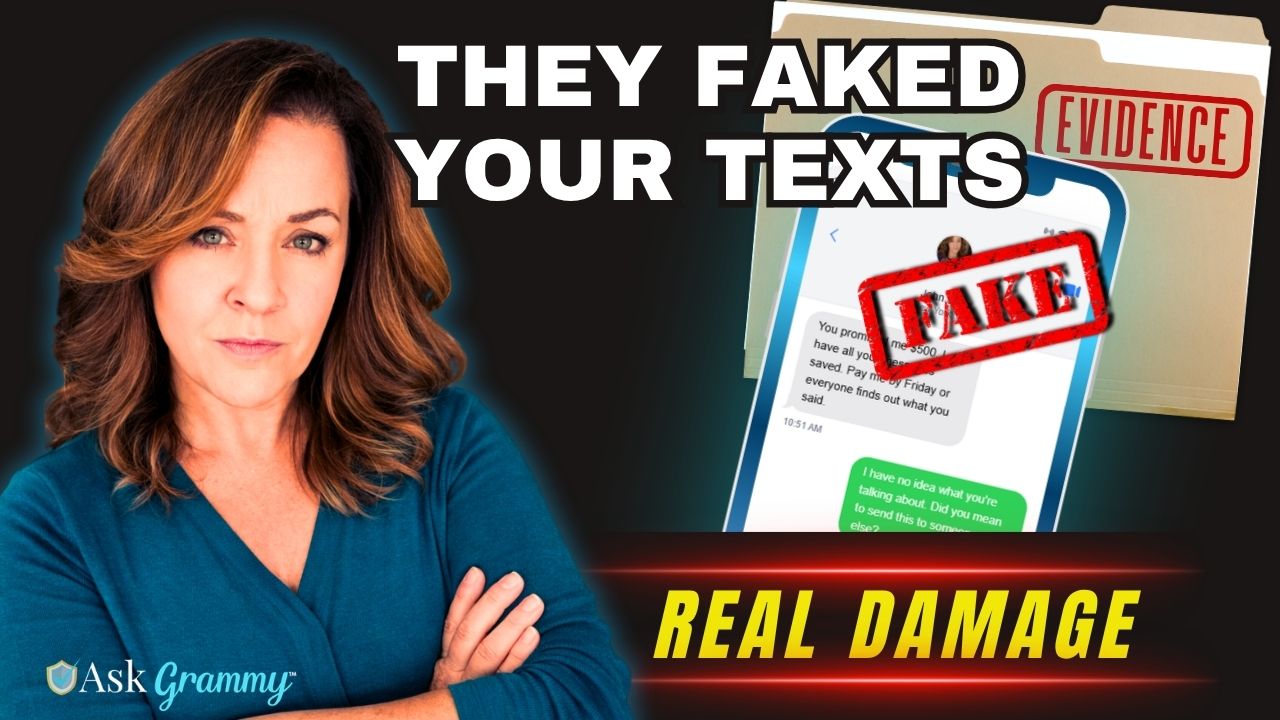
There are tools available right now – easy to find, completely free, and openly advertised – that let anyone create a convincing fake text message, a fake Facebook post, a fake Instagram DM, a fake WhatsApp conversation, or a fake Tweet. From scratch. In minutes.
And people are using them to build fabricated evidence files that are being taken at face value.
In courtrooms. In HR departments. In custody hearings. By police officers. By family members who should know better.
Let’s talk about this.
Prefer to watch? You can see the full video here:
What These Sites Actually Do
I’m not going to link directly to these sites – I don’t want to send them traffic – but I will name them, because you need to know they exist.
faketextgen.com lets you create fake iPhone-style text conversations. You choose the contact name, upload any profile photo, write the messages, set the timestamps, and export as an image. The result looks indistinguishable from a real screenshot to the untrained eye.
ifaketextmessage.com goes even further. You can set the carrier name, the signal strength, the connection type, the battery level, whether bluetooth is showing, whether the alarm or Do Not Disturb indicator is visible. Every status bar detail. Every little thing that might make someone say “wait, that doesn’t look like my phone” – you can fine-tune it away.
zeoob.com is where this stops being just a text message problem. This site offers fake generators for every major platform: Instagram posts, Instagram DMs, Tweets, Twitter DMs, Snapchat DMs, Facebook posts, Facebook Messenger chats, WhatsApp conversations, iMessage, and TikTok posts.
One website. Every platform. All of it fakeable.
There are others too. Some throw up browser security warnings when you try to visit them — which tells you everything you need to know about how responsibly they’re run.
The Scenarios That Should Concern You
Custody Battles
Imagine you’ve been careful. You’ve kept every text civil. You’ve been generous, polite, and deliberate because you knew your messages might end up in front of a judge.
Your ex shows up in court with a folder.
In that folder is a text thread showing you making threats. A Facebook post showing you in a rage, posted at 2am and “deleted before anyone could see it.” Maybe an Instagram DM that suggests something inappropriate.
All of it fabricated. All of it looking completely real. Timestamped. Platform-accurate. Detailed.
The judge sees it. The custody evaluator sees it. It goes in your file.
How do you prove it’s fake?
That’s a genuinely hard problem. Most people receiving that folder – lawyers, HR managers, family court judges, police officers – don’t have the tools or the training to question a convincing screenshot.
Workplace Extortion
“Pay me or I send these to your employer.”
A fake screenshot showing you saying something racist, threatening, or sexually inappropriate. It doesn’t matter that you never said it. The damage from even the accusation reaching your workplace before you can defend yourself could cost you your job.
Relationship Extortion
“Pay me or I send these to your spouse.”
Fake evidence of an affair. Fake flirtatious messages. Fake arrangements. Your marriage is on the line and you’re trying to prove a negative.
Romance Scam Leverage
A scammer builds a fake relationship, then suddenly produces “screenshots” of the victim saying things they never said. Uses them as leverage. “I’ll show everyone what you said to me unless you send money.” The victim is too embarrassed and scared to fight back.
Elder-Targeted Manipulation
“Grandma, you said you’d help me. I have the texts right here. Why are you doing this to me?”
A confused older adult, a convincing screenshot, a family dynamic already under strain. This one hits different.
To Be Fair – Legitimate Uses Do Exist
Before I go further, I want to be clear: these tools aren’t illegal, and there are legitimate reasons they exist.
Parents use them to show teenagers what a grooming message looks like before a predator sends one. Teachers use them for digital literacy lessons. Scam awareness educators use them to demonstrate what a fake message looks like in action.
The tools themselves aren’t inherently evil. But the potential for misuse is enormous – and most people have absolutely no idea these sites exist.
How to Spot a Fake Screenshot
Certified digital forensics experts at Envista Forensics – a legitimate forensic investigation firm that has testified in court cases involving fabricated text evidence – have identified several visual tells to look for.
None of these are foolproof. A careful faker can avoid most of them. But they’re a starting point.
Look for inconsistent fonts, text sizes, or spacing. Real messaging apps are consistent. If something looks slightly off in the typography, that’s worth noting.
Check the timestamps. Do they make logical sense? Is there a gap in the conversation that feels wrong? Are the times in an unusual order?
Look at the status bar details. Does the carrier, battery level, or signal indicator match what you’d expect from that person’s phone? Details that don’t match their actual device can be a tell.
Look for blurry or pixelated areas around the text. This can happen when a screenshot has been edited in photo software like Photoshop.
Look for repeated patterns or duplicated elements. Sometimes the clone stamp tool leaves visual artifacts.
Notice missing context. Conversations that start suspiciously, skip logical exchanges, or feel weirdly incomplete may have been selectively constructed.
Trust your gut. If a conversation doesn’t sound like the person you know – their phrasing, their punctuation habits, their way of expressing themselves – that instinct is worth following.
What to Do If You’re Facing Fabricated Evidence
If this is happening in a legal context, get a digital forensics expert involved immediately. Not just an IT person. A certified mobile forensics examiner. Real forensic analysis doesn’t look at a screenshot – it pulls data directly from the actual device, with cryptographic verification that proves whether the data has been altered. That’s the kind of evidence that can actually defend you.
The Envista Forensics article I’m linking below goes into detail on exactly how this works. It’s worth reading, especially if you’re navigating anything legal right now.
Talk to your attorney about requesting a proper forensic examination rather than simply arguing that a screenshot looks wrong. The standard of proof matters.
Document your real conversations using legitimate methods. If you’re in any situation where your messages might later be disputed, ask your attorney about legal-grade documentation options available in your state.
The Bigger Picture
Here’s what I keep coming back to.
We’re not just talking about strangers and scammers. The people most likely to build a convincing fake evidence file against you are people who already know you. An ex-partner. A disgruntled former colleague. A family member in a dispute over an estate. Someone who knows your phone carrier, your photo, what time you usually text, what your writing style sounds like.
Someone who can get the details right because they know the details.
A completely fabricated evidence file – fake texts, fake posts, fake DMs across multiple platforms – is something one person can now build in an afternoon with zero technical skill and a free internet connection.
That’s the world we’re living in.
A screenshot is not proof. It never technically was. But most people have been treating it like it is. That needs to change – and it starts with knowing this is possible.
Quick Reference: Red Flags Checklist
Print this out. Keep it somewhere.
- Inconsistent fonts, text sizes, or spacing
- Timestamps that don’t make logical sense
- Mismatched carrier, battery, or signal icons
- Blurry or pixelated areas around text
- Repeated patterns or duplicated elements in the image
- Conversations that feel incomplete or missing context
- Phrasing or style that doesn’t sound like the person
- Screenshots that only show the most damaging moments with no surrounding context
- No way to verify the original device
About This Investigation
This post is based on original research conducted by Christine Durst at AskGrammy.com, including direct testing of the sites described. Supporting source: Envista Forensics, “Pixels and Perjury: The Alarming Ease of Fabricating Text Message Evidence and What to Do About It” (October 2025), available at envistaforensics.com. Envista Forensics is a professional digital forensics firm whose experts have testified in court cases involving fabricated digital evidence.
No affiliate relationships exist with any sites mentioned. Sites are named for consumer awareness purposes only.