
Summary
This email threatened me with legal action if I didn't respond within seven days. It's a scam, and the tricks it uses show up in fake bank, IRS, and package emails every single day.
The email gave me seven days. Respond in writing, it said, “or our client may pursue appropriate legal remedies.”
It had a law firm letterhead. A reference number. My name and email address. It even quoted real sections of U.S. law. And at first glance, I’ll be honest, it looked real.
It was a scam. And here’s the good news. Once you see how this one was put together, you’ll spot the same tricks in fake bank emails, fake IRS notices, and fake package alerts. In seconds.
Meet the Frankenstein email
Remember Frankenstein’s monster? He was stitched together from spare parts. An arm here, a leg there. He was an ugly mess, but he walked, he talked, and he scared the daylights out of people.
Scammers build emails the same way. They grab real pieces of information about you, sew on some official-sounding language, bolt on a deadline, and send the whole thing lurching into your inbox. It doesn’t have to be perfect. It just has to be scary enough to make you act fast.
You may never get a fake legal notice like mine. But you will get an email built from the same parts. So let’s put this monster on the operating table and take it apart, one piece at a time.
Red flag #1: A vague subject line and a too-convenient date
The subject line was nothing but a string of numbers and a date. No case name. No client. No hint of what it was about.
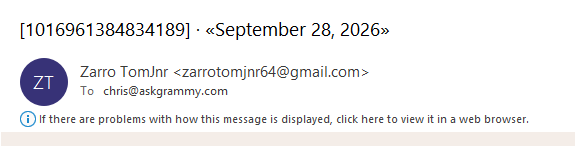
A real, important notice wants you to know right away what it’s about. A vague one is vague on purpose. Scammers want you curious enough to open it.
Then look at the dates. The email was sent September 28. The “date of discovery,” the day they supposedly found the problem, was also September 28.
So on one single day, somebody found the problem, tracked down who it belonged to, hired a law firm, and got a formal legal notice out the door? That’s awfully speedy. It’s not impossible. But it’s exactly what you’d expect from a computer program that stamps today’s date on every letter it spits out.
Red flag #2: An “official” notice from a free Gmail account
The email came from someone called Zarro TomJnr, at a Gmail address.
I have yet to see a real law firm send official notices from a free Gmail account. Same goes for banks, the IRS, and real delivery companies. Real organizations send email from their own web address, something like name@theircompany.com.
Here’s a twist. There’s a creator on Facebook named Zarro Tom Junior who has been posting since 2017. I’m not saying he had anything to do with this. But it sure looks like whoever sent it borrowed his name.
✅ Quick check: Look at the actual email address, not just the name it displays. If an “official” message comes from Gmail, Yahoo, Outlook, or any other free account, be very suspicious.
Red flag #3: Nothing in the letterhead matches
The letterhead said “Law Offices of Robinson,” with a San Diego address, a phone number, and an email address. So I checked every single piece.
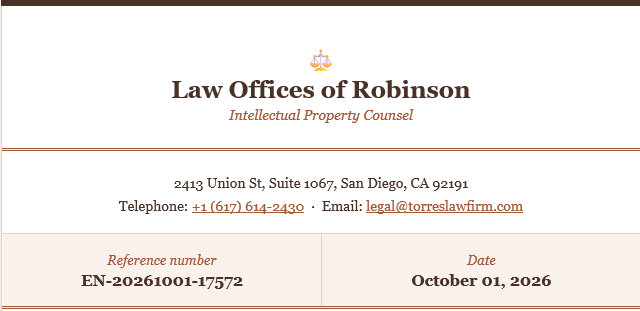
The firm. A quick Google search turned up a real Robinson law office that handles this kind of law. It’s in Tennessee, not San Diego.
The street address. 2413 Union Street, Suite 1067, San Diego. That’s a residential neighborhood, and there’s no number 2413.
The phone number. It starts with 617. I’m a Connecticut girl, and I recognized that area code right away. That’s Boston, Massachusetts, not California. I searched the number, and it isn’t connected to any law firm.
The email address. And this is the part that made me laugh out loud. The firm’s email was legal@torreslawfirm.com.
Torres. Not Robinson. Torres.
The letter claims to be from one law firm and hands you an email address for a completely different one. Torres is a real law firm in San Diego, by the way. It handles immigration law, which has nothing to do with this letter.
Scammers are in such a hurry to stitch these monsters together that they skip parts. This time, they forgot the brain.
That’s four red flags in one little block of text. A fake firm name, an address that doesn’t exist, a phone number from the wrong state, and somebody else’s email address.
Quick check: Does the name match the email address? Does the street address really exist? Is the phone number’s area code from where they claim to be? You can answer all three in a couple of minutes.
Red flag #4: The monster’s roar
Next came a pile of official-sounding details. They named a company I had supposedly taken something from. They included my name, my email address, and other information about me. And they quoted real sections of U.S. law.
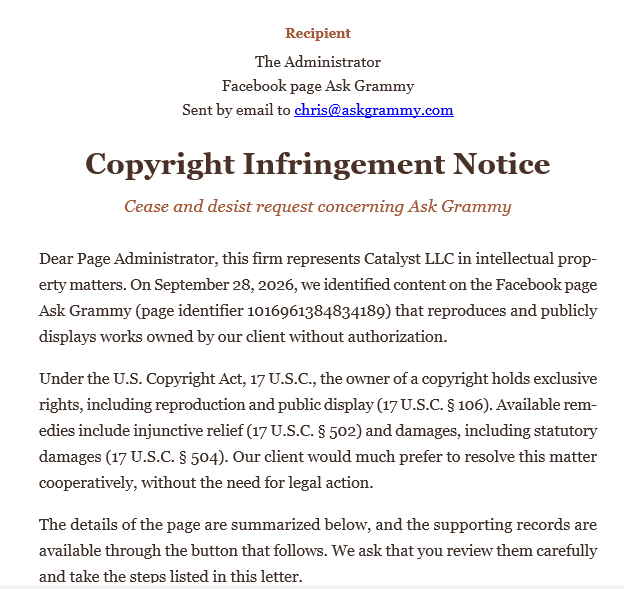
That’s the monster’s roar. It’s meant to sound big and terrifying.
But quoting a real law doesn’t make a claim real. And knowing your name and email doesn’t make someone legitimate. That kind of information is easy to find online, and scammers collect it by the bucketful. Fake IRS emails quote tax rules. Fake bank emails use real bank logos. It’s all the same roar.
If you’ve ever felt your stomach drop when an email used your real name, that’s not you being gullible. That’s the trick working exactly the way it was designed to.
Red flag #5: The button is a trap door
If you remember only one thing from this post, make it this. Never touch the monster’s button.
This email had a big button that said “Open the case records.” When I rested my mouse on it, without clicking, a little box popped up showing where it really went. It was a Google sharing link.

Some scammers now use real Google links to sneak past spam filters. A link can look like it comes from a company you trust and still be dangerous.
Links like this can take you to a fake login page that steals your password, or to a site that puts something harmful on your computer. In this case, I suspect it leads to a “let’s settle this quietly” request for money.
Quick check: On a computer, rest your mouse over a link without clicking and look at the web address that appears. On a phone, don’t tap at all. If you weren’t expecting the email, don’t click the link. Ever.
Red flag #6: The to-do list is the real weapon
Now here’s where it gets sneaky. The email included a list of “Requested Actions”:
- Review the case records and confirm you got this notice. (Which, conveniently, means clicking the button.)
- Remove the content and don’t post it again.
- Save all related posts, messages, and history.
- Reply to the firm’s email once you’re done.
It looks like paperwork. It’s actually a set of psychological hooks.
They want a reply. One reply tells a scammer your email account is active, a real person reads it, and that person responds when scared. Congratulations, you’ve just been marked as a good target.
It’s a foot in the door. Once someone agrees to a few small, easy requests, they’re far more likely to agree to a big one later. Like sending money.
“Save everything” is pure theater. Anyone who’s watched a courtroom drama knows that sounds serious, like a lawsuit is already on its way.
The list is meant to overwhelm you. A long, official-looking checklist makes the whole thing feel heavy, so you rush to make it go away.
And then the final shove: reply within 7 days, or else.
A deadline plus a threat is the classic scammer combo. You’ll see it in “your account will be closed in 24 hours,” “pay now or a warrant will be issued,” and “your package will be returned today.” It’s built to make you act before you think.
Your Frankenstein checklist: 6 ways to spot a scam email in seconds
Save this list. Print it. Stick it on the fridge. Use it any time a scary or urgent email lands in your inbox.
- Check who sent it. A free email account, or a name that doesn’t match the address, is a big warning sign.
- Make sure the details match. Does the name match the email address? Does the street address exist? Is the phone number from the right state?
- Look the company up yourself. Use contact information you find on your own, never the information in the email.
- Never click the button or link. Rest your mouse on it to see where it goes, then walk away.
- Don’t reply. Not even to say “I know this is fake.” A reply tells them you’re a real person.
- Watch for the deadline-plus-threat combo. Real problems give you time to check things out. Scammers don’t.
What to do if a scary email lands in your inbox
First, breathe. Don’t panic, and don’t respond.
If you’re worried the problem might be real, contact the company or agency directly. Use a phone number you found yourself, on their real website or on a statement you already have.
And you’re always welcome to send it to me.
If you already replied or clicked before you knew better, please don’t beat yourself up. These emails are built by people who scare folks for a living. Stop responding, don’t click anything else, and if you typed a password into a page the email sent you to, change that password right away.
Frequently asked questions
Can a law firm really send legal notices by email? Law firms do use email. But a real firm writes from its own web address, not Gmail, and its name, address, and phone number will all match up when you check them.
How can I tell if a link in an email is safe? On a computer, rest your mouse over the link without clicking and read the address that pops up. But even a link that looks legitimate can be dangerous. If you weren’t expecting the email, don’t click.
Why do scam emails have my real name and information? Your name, email address, and other details are easy to find online. Scammers gather them up to make their emails feel personal and believable. Knowing your name doesn’t make them legitimate.
Should I reply to tell a scammer I know it’s fake? No. Any reply confirms your email address is active and that a real person reads it. That can bring on even more scam attempts.
What does “Frankenstein email” mean? It’s my name for scam emails stitched together from real pieces of information, official-sounding language, and a scary deadline. They aren’t perfect, but they’re just believable enough to make you act fast.
Have you gotten a Frankenstein email?
Tell me in the comments. What did it claim to be? Your stories help me decide which monsters to dissect next.
And if this made you think of someone who might panic over an email like this, a parent, a friend, or a neighbor, please share it with them. They’re exactly who these scammers are counting on.
Want more scam dissections like this one? Bookmark this page and follow me on Facebook and YouTube – I’ll keep taking these monsters apart for you.
Be so careful out there, and do your homework. Take care of yourselves and each other.