
Summary
⚠️ Quick Summary
Scammers are using AI deepfakes and stolen celebrity photos to build fake romantic relationships online - then stealing everything. One woman lost $850,000 to a fake "Brad Pitt." Another drove an hour to a hotel to meet "Kevin Costner." The FBI reported $672 million in romance scam losses in 2024 alone. This post covers how the scam works, real victim stories, and exactly what to watch for.
How Celebrity Impersonation Scams Are Stealing Millions From Real People
A woman in France fell in love with Brad Pitt.
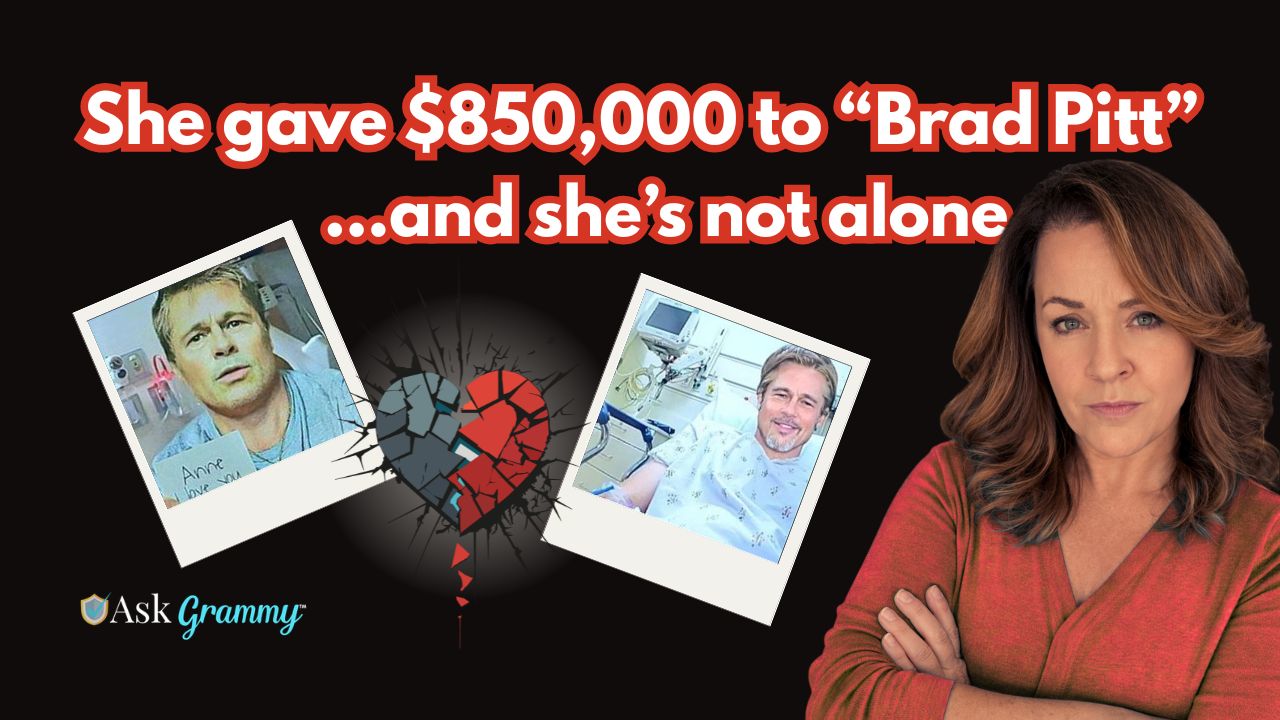
Over 18 months, he sent her daily love messages and poems. He sent her photos of himself – including one from a hospital bed, where he was recovering from kidney cancer. He told her his accounts were frozen because of his divorce from Angelina Jolie. He needed her help.
She transferred nearly $850,000 to accounts in Turkey. She divorced her own husband. She was preparing to start a new life.
The relationship ended when she saw a real photo of Brad Pitt with his actual girlfriend.
The man she had been talking to was not Brad Pitt.
The hospital photo was generated by artificial intelligence.
And she is not alone.
Watch Grammy’s video about this scam here:
Prefer to read? Keep scrolling. Everything in the video is covered below – and then some.
About This Investigation
This post is based on research from multiple credible sources, including McAfee’s 2025 Most Dangerous Celebrity Report, an investigative feature from The Hollywood Reporter, reporting from RadarOnline, and data from the FBI’s Internet Crime Complaint Center. All victim stories are sourced directly from that reporting. No facts have been invented or extrapolated. I’m sharing these stories because the people they happened to deserve to have their experiences taken seriously – not as cautionary tales about gullibility, but as evidence of sophisticated, well-funded criminal operations targeting everyday people.
The List You Need to See
In 2025, cybersecurity firm McAfee surveyed more than 8,600 people worldwide and published a report identifying the celebrities whose likenesses are most frequently weaponized in online scams. Their findings identified the ten most impersonated celebrities in the world:
- Taylor Swift
- Scarlett Johansson
- Jenna Ortega
- Sydney Sweeney
- Tom Cruise
- Alexandria Ocasio-Cortez
- Sabrina Carpenter
- LeBron James
- Kim Kardashian
- Zendaya
That list covers everyone from teenagers’ favorite pop stars to a sitting member of Congress. There is someone on that list that every single person reading this post recognizes and trusts.
That is not a coincidence. That is the point.
McAfee’s research also found that 72% of Americans have already seen a fake celebrity or influencer endorsement online. Nearly 4 in 10 have clicked on one. And 1 in 10 of those people lost money or personal data – averaging $525 per victim.
Those numbers are for endorsement scams – fake ads, fake giveaways, fraudulent product promotions. When we talk about romance scams, where victims believe they are in an actual personal relationship with a celebrity, the losses are in another category entirely.
The FBI reported $672 million in losses to confidence and romance scams in 2024. People over 60 filed the most complaints and lost the most money, averaging $83,000 per victim. And those figures do not include the people who never reported what happened to them – because they were too ashamed, too afraid, or because some small part of them still wasn’t sure it hadn’t been real.
Why Celebrities? The Psychology Behind the Scam
Before we get into the individual stories, it’s worth understanding why celebrities make such effective bait.
The formula is straightforward, even if the execution is sophisticated.
Scammers take someone you already trust. Someone you already admire. Someone you may have had feelings about for years – an actor you’ve watched in dozens of films, a musician whose songs have been the soundtrack to your life. And they use that existing emotional connection as a weapon against you.
You don’t need to be convinced to like this person. You already do. You just need to be convinced that they like you back.
“Celebrities just have so many images out there,” says Nick Berta, a supervisory special agent in the FBI’s economic crimes unit, in a July 2025 Hollywood Reporter investigation. “The ease with which scammers can use their tools to manipulate voice and audio and video, it’s very difficult for public figures to protect themselves.”
Former prosecutor Erin West, who specializes in high-tech crimes, described the psychological hold these scammers have over their victims this way: “It is cult-like. It absolutely overwhelms any type of reasonable thought. They’re able to overcome what humans would normally discern to be a ridiculous situation.”
That is not a description of gullible people making foolish choices. That is a description of professionals – skilled, practiced, and deliberate – doing exactly what they have been trained to do.
Keanu Reeves Is Not in Love With You
Keanu Reeves may be the most impersonated celebrity on the internet.
The reasons are worth understanding, because they apply beyond just one actor.
Reeves has no real social media accounts. He doesn’t share much about himself publicly. He is universally liked – across ages, cultures, and demographics. The information vacuum created by his privacy is filled by scammers with whatever version of Keanu their target needs him to be.
In July 2025, Hollywood Reporter senior editor Rebecca Keegan decided to see exactly how fast these scams move. She created a fake social media profile of a woman she named Linda. She used AI to age up one of her own selfies and invented a dead husband named Bob and a scruffy dog named Milo. Then she followed a handful of celebrity fan pages and waited.
Within 90 minutes, an account called Keanu_Reeves68667 was in her direct messages.
Within two hours, she had five fake Keanus in her DMs – along with two fake Kevin Costners, a fake Charlie Hunnam, and a fake Jonathan Roumie, the actor who plays Jesus on the Christian series The Chosen.
Five fake Keanus. In two hours.
Once Keegan allowed the fake Keanu to move the conversation to Telegram – which scammers push for quickly, because social media platforms will eventually shut down their fake accounts – he sent her tinny voice memos and began building toward a request for money. Specifically, a $600 “fan club membership card” that would allow them to “meet in person for sure.”
When Keegan invented a daughter she would need to consult before sending money, the scammer deployed a tactic that should send a chill down your spine.
He told her to keep their relationship secret.
“I don’t think letting your daughter know about our relationship is the best thing now, Linda. Do you understand that no one will believe you talked to me? You need to keep our conversations away from your families. Let it be just you and I.”
That is not a celebrity who wants privacy. That is an abuser’s playbook. Isolate the victim. Create secrecy. Cut them off from the people who love them and might ask uncomfortable questions.
The moment anyone online asks you to keep your relationship with them a secret from your family – that is your signal to leave.
Keanu Reeves Is Doing Something About It
Here is the part of this story that offers a little hope.
Keanu Reeves is not passively accepting the weaponization of his identity. He has partnered with a Seattle-based company called Loti AI, which uses facial recognition technology to scan the entire internet every single day, looking for unauthorized use of his image and identity.
In one year alone, Loti issued nearly 40,000 takedown orders on Reeves’ behalf across platforms including TikTok, Facebook, and Instagram.
Forty thousand.
Reeves also pays Loti to protect the people around him – his publicist, members of his inner circle – because scammers will impersonate them too, to add a layer of credibility to their approach.
Loti offers services to non-celebrities as well, including a free tier for people who want to know if their own face and identity are being used somewhere online without their knowledge. I’ve included a link at the bottom of this post.
Meanwhile, some 400 performers – including Scarlett Johansson and SAG-AFTRA president Fran Drescher – have signed on to support federal legislation called the No Fakes Act, which would create legal protections for artists’ voices, likenesses, and images from unauthorized AI-generated deepfakes.
Margaret, Kevin Costner, and a Hotel Room in the South
Margaret is 73 years old. She is a retired office manager from the rural South. She delivered a TED talk. She was accomplished, experienced, and – by any reasonable measure – nobody’s idea of an easy mark.
She lost $100,000.
Over several months, Margaret communicated with someone on Facebook who presented himself as Kevin Costner. He told her he needed financing for a new production company, and that she would come to work for him once it was established. She made weekly Bitcoin deposits.
And then one day, he sent her a photo. It appeared to show Kevin Costner leaning against a wooden headboard in a white T-shirt, holding a handwritten piece of paper. The paper read: “it’s really me Kevin Costner I love you so much MARGARET I can’t wait to meet you MARGARET.”
Her name. Handwritten. Personal. Just for her.
She packed her suitcases weeks in advance.
In November, she got in her Toyota Camry and drove an hour to a hotel, where she was certain Kevin Costner was coming to meet her.
He sent her a photo of a mangled car. He said he’d been in an accident and couldn’t make it.
As she sat in that hotel room, the warning signs she had been pushing away for months began to surface. She spent the night there, alone, beating herself up.
In the vulnerable weeks that followed, someone new reached out – a person claiming to be Costner’s adult daughter Annie, calling Margaret “Mom” and offering comfort. Then came someone claiming to be a Sons of Anarchy actor. Then a country music star.
Because here is what happens once a scam has worked on someone: their information gets shared. Not on a Do Not Call list. On what the Hollywood Reporter described as a “Susceptible With Money” list. It gets sold to the next scammer, and the next.
Margaret’s sister Carol watched it happen in real time. “She was always my big sister that I looked up to,” Carol told the Hollywood Reporter. “I feel like she’s gotten isolated now, and I’m sure that’s the purpose of it.”
By the time the story was published, Margaret’s divorce was final. She had handed over her house – and land that had belonged to her grandmother – to her ex-husband in exchange for cash.
She said she needed the money.
The Brad Pitt Hospital Photo
Anne’s story begins on Instagram, with a message from someone claiming to be Brad Pitt’s mother.
From there, the relationship developed over 18 months. The fake Brad Pitt sent daily love messages. He sent poems. He sent AI-generated photos – including one that showed him in a hospital bed, appearing to be ill. He told Anne he had kidney cancer. He told her his accounts were frozen because of his divorce from Angelina Jolie. He needed her financial help to access medical treatment.
Anne transferred €830,000 – nearly $850,000 – to accounts in Turkey. She divorced her husband. She was preparing to begin a new life.
It ended when she saw a genuine photo of Brad Pitt with his real girlfriend and realized the person she had been communicating with was not who he claimed to be.
The hospital photo was not real. It was created by artificial intelligence – designed to look authentic, designed to create urgency, designed to bypass every reasonable instinct Anne had.
Brad Pitt’s team subsequently reminded the public: Brad Pitt has no personal social media accounts.
Neither does Keanu Reeves.
Neither does Kevin Costner.
That detail matters more than almost anything else in this post.
The Scammer on the Other Side of the Screen
There is one more layer to this story that I think is important to include – because it matters for how we understand what is actually happening here.
The Hollywood Reporter’s investigation revealed that many of the people running these scams are not the criminal masterminds we might imagine. They are frequently trafficking victims themselves – people who responded to what appeared to be a legitimate job listing in countries like Thailand, were taken across borders into Myanmar, Cambodia, or Laos, had their passports confiscated, and were imprisoned in compounds where they work 16-hour days reading from scripts written by experts in human psychology.
“This is industrialized scam,” said Erin West, the former prosecutor, in the Hollywood Reporter piece. “It’s a growing industry, and it’s growing because it works.”
I am including a link to the full Hollywood Reporter investigation in the resources section below. The part of their reporting that covers the trafficking angle is worth reading in full.
This does not make the harm to victims any less real. It does not make the financial losses any less devastating. But it does complicate the picture in ways that are worth sitting with — and it speaks to the scale and sophistication of what we are actually dealing with.
The Red Flags: What to Watch For
If you take nothing else from this post, take this list. Print it out. Share it with someone you love.
A celebrity contacts you directly. It is not happening. Keanu Reeves is not DMing you on Facebook. Kevin Costner is not sliding into your Instagram messages. If it looks like a celebrity reached out to you personally – it is a scammer. This is not a judgment about you. It is simply true.
They want to move to a private app quickly. Telegram. WhatsApp. Google Chat. Signal. They do this because social media platforms will eventually identify and shut down their fake accounts. Once you are in a private messaging app, there is no oversight and no safety net.
They tell you to keep the relationship secret. “Don’t tell your family.” “My management team wants this kept private.” “No one would believe you anyway.” Any version of this is an isolation tactic. It is control. It is the first step in cutting you off from the people who might help you see clearly. Walk away.
They need money. For anything. Medical bills. Legal fees. Travel expenses to come see you. A business venture they want you to be part of. Bitcoin. Gift cards. Wire transfers. No celebrity is asking you for money. Not for any reason. Not ever.
They cannot video chat – or their video is strange. Real people can video chat in real time. Scammers avoid it because live deepfakes are harder to execute convincingly, though that technology is improving rapidly. Repeated excuses about why they cannot appear on video are a significant warning sign.
They personalize everything. Your name on a handwritten note. References to details you shared weeks ago. Compliments that feel specific to you. This is not romance. This is a script refined by professionals who study exactly what lonely, trusting people need to hear.
What to Do Right Now
Verify through official channels. If someone contacts you claiming to be a celebrity, go directly to that celebrity’s verified official account and look at how they communicate with fans. They are not sending personal DMs. They are not asking for money. They are not falling in love with you in a private chat.
Do a reverse image search. Right-click any photo a suspicious contact sends you and search Google for that image. If it appears across multiple websites with different names and contexts, it has been stolen or fabricated.
Tell someone before you send money. I know this feels embarrassing. I know it feels personal. But talking to a family member or trusted friend before sending a single dollar is one of the most protective things you can do. The act of saying it out loud to someone who loves you often breaks the spell.
Report it. If you or someone you know has been victimized, please report it. You are not stupid for being targeted. These are professionals operating at industrial scale. Reporting protects the next person.
- FTC Report Fraud: reportfraud.ftc.gov
- FBI Internet Crime Complaint Center: ic3.gov
Scam Checklist: Is This Real?
Use this checklist any time an online contact raises questions in your mind.
- Did this person contact ME first, out of nowhere?
- Are they claiming to be a celebrity, public figure, or person of high status?
- Have they asked me to move our conversation to a private app?
- Have they asked me to keep our relationship secret from family or friends?
- Have they asked me for money, gift cards, Bitcoin, or wire transfers?
- Do they have excuses for why they cannot video chat in real time?
- Does their profile have few followers but follow many people?
- Do their photos look slightly off, or do reverse image searches show them elsewhere?
If you checked even two or three of these boxes – stop. Talk to someone you trust before taking any further action.
Resources
- 🔗 McAfee 2025 Most Deepfaked Celebrities Report: https://www.mcafee.com/blogs/internet-security/the-stars-scammers-love-most-mcafee-reveals-worlds-most-deepfaked-celebs/
- 🔗 The Hollywood Reporter — This Is Not Keanu (full investigation): https://www.hollywoodreporter.com/business/digital/hollywood-celebrity-impersonation-scam-1236309121/
- 🔗 AOL/RadarOnline — Celebrity Scams Exposed: https://www.aol.com/articles/exclusive-investigation-celebrity-scams-exposed-150000406.html
- 🔗 FaceCheck.ID — Celebrity Romance Scams 2026: https://facecheck.id/Face-Search-Celebrity-Romance-Scams
- 🔗 Loti AI (takedown services, including free tier): https://loti.com
- 🔗 FTC Report Fraud: https://reportfraud.ftc.gov
- 🔗 FBI Internet Crime Complaint Center: https://ic3.gov
One Last Thing
Margaret packed her suitcases weeks before she drove to that hotel.
Anne transferred her life savings over 18 months.
A San Diego widow lost everything she had.
These women were not careless. They were not foolish. They were human – and they were targeted by people who have made a profession of exploiting the most human things about us. The desire to be loved. The willingness to trust. The hope that something extraordinary might happen.
If this post helped you – or if it made you think of someone who needs to read it – please share it. You might be saving someone a hotel room they drive to alone. Or a suitcase that never gets unpacked.
I’ll see you next time, Friends.
Have a question or a scam to report? Visit AskGrammy.com or leave a comment below.