

Every week, I hear from people about emails that say something like:
We were unable to process your Netflix payment. Your account will be suspended unless you update your information immediately.
Sometimes it’s Netflix. Sometimes it’s Amazon, Hulu, Apple, or a credit card. The wording changes, but the goal doesn’t: to push you to act before you pause.
These emails don’t look clumsy anymore. Many are clean, familiar, and easy to mistake for routine account notices. That’s why they work.
Why these emails feel convincing
Subscription services really do bill automatically. Cards really do expire. Accounts really do get paused sometimes. Scammers aren’t inventing a new story; they’re borrowing one people already expect.
They also borrow tone: neutral language, short explanations, and a clear next step. The message doesn’t sound dramatic. It sounds procedural.
That familiarity is the hook.
A real example
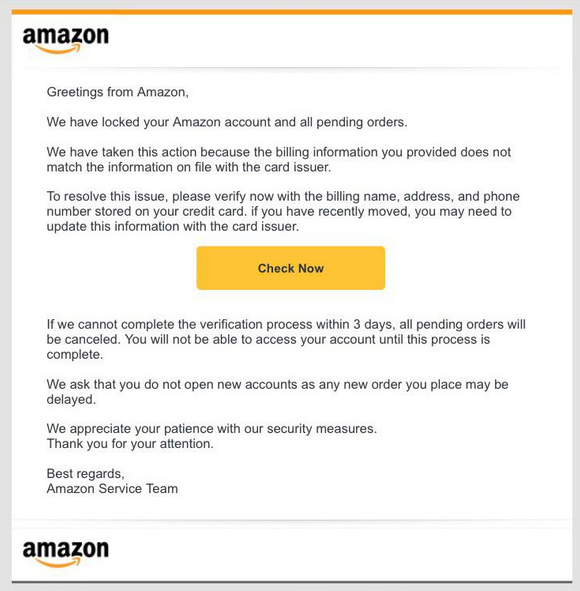
Below is a screenshot of an email claiming to be from Amazon. It states the recipient’s Amazon account has been locked and their billing information needs to be updated through the included link within 3 days.
The email looks legitimate: it used Amazon’s logo, has professional formatting, and even includes a reference number in the subject line (not shown). However, if you hover over the “check now” link with your on-screen mouse pointer and look at the lower left corner of your screen, you’ll discover it leads to a suspicious web address, not Amazon’s official site.
This kind of targeted, convincing attempt is common now.
In cases like this, DON’T CLICK THE LINK. If you want to ensure your account is fine, go directly to Amazon.com and you’ll likely be reassured everything is normal.
How to tell a phony email from a real one
No single sign proves an email is fake. What matters is the pattern.
1. It asks you to act inside the email
Legitimate companies may notify you of an issue, but they usually expect you to open their app, use a saved bookmark, or log in the way you normally do.
Scam emails push you to resolve everything through the message itself.
2. The link doesn’t go where it claims
As noted above, hover over the link, don’t click. If it doesn’t clearly lead to the company’s real domain in the lower-left corner of the screen, stop there.
Some scams use convincing look-alike addresses. Others hide the destination entirely. Either way, the mismatch is the tell.
3. The problem is vague on purpose
“You owe money.” “Your payment failed.” “Action required.”
There’s rarely a date, amount, or reference to your actual account. Specifics would make the message easier to verify, and easier to disprove.
4. The timing is meant to catch you off guard
Many of these emails arrive early in the morning, late at night, or right before a weekend — making it less likely you’ll catch customer service in the office. Urgency alone isn’t proof of a scam. Urgency paired with vagueness is.
A note on nuance
Not every unexpected billing email is fake. Companies do send alerts. Accounts do have problems.
The difference is whether the message pushes you to resolve the issue on their terms or lets you verify it on yours. That distinction matters more now than it used to.
What to do if you clicked
If you already clicked a link or entered information:
- Go directly to the real service and change your password
- Check recent account activity and billing history
- If you used the same password elsewhere, change it there too
- Watch for follow-up emails – one success often leads to more attempts
You don’t need to panic. You do need to close the door.
Grammy’s Closing Thoughts
Phony billing emails succeed by sounding ordinary. They rely on habit.
The moment an email asks you to fix a problem by clicking right now, step out of the message and check the account another way. Real issues survive scrutiny. Fake ones depend on avoiding it.
If you’re ever unsure, assume the email can wait – and let the real account speak for itself.
Remember, friends, caution is not paranoia; it’s a reasonable response to systems that move faster than trust can keep up.
– Grammy