
Summary
This post exposes a network of fake and unverifiable animal rescue pages operating across Facebook, TikTok, and YouTube. Most claim 501(c)(3) nonprofit status but have no IRS record. The post explains the psychology behind why these emotional fundraising tactics work so well, walks through specific pages investigated, and gives readers a clear checklist for verifying any rescue organization before donating.
If you ever find yourself wanting to both love and hate your fellow humans, take up investigating scams. It’s a quick way to see the best and the worst of our kind all in one place.
This investigation is a perfect example of that. On one side, you’ve got people who are willing to do everything they can to help innocent animals in need. On the other, you’ve got people who’ve figured out exactly how to turn that kindness into cash – with zero intention of helping a single animal.
This one started with a comment. A follower named Lorin asked me to look into equine, donkey, and pet rescue pages that are constantly running emotional fundraising appeals on social media. So I looked. And Lorin? I’m really glad you asked. I found a mess that other animal lovers need to learn about.
Stolen videos. Fabricated urgency. Pages claiming to be registered nonprofits that don’t exist as far as the IRS is concerned. And in some cases, operations that appear to be run from outside the United States, using fake American addresses to collect donations from people who think they’re helping animals down the road.
Let me show you what I found – and more importantly, how to protect yourself before you ever donate to one of these pages.
Prefer to read? Keep scrolling. Everything in the video is covered below.
About This Investigation
This investigation was conducted between May 23 and May 26, 2026. Organization names were searched in the IRS Tax Exempt Organization Search at apps.irs.gov/app/eos. All findings reflect results at the time of publication. This post is intended for consumer education purposes and does not constitute legal advice. If you believe you’ve been the victim of charitable fraud, you can file a complaint with the FTC at reportfraud.ftc.gov or contact your state attorney general’s office.
Why These Scams Work So Well – It’s Not an Accident
Before we get into the specific pages I investigated, I want to walk you through the playbook. Because these operations are not random. They’re running a very deliberate emotional strategy, and once you see it named, you’ll spot it everywhere.
Fond Memories
You don’t need to currently own a pet to feel the pull of a sad animal post. A lot of us grew up with a dog or a cat. That memory lives somewhere warm, and these pages know exactly where to find it.
The Named Victim
‘Charlie needs $1,200 by Friday or he goes to a kill shelter.’
You can scroll past a sad, nameless dog. You cannot scroll past Charlie. There’s actual psychology behind this – researchers call it the identified victim effect. A nameless group in need doesn’t move people nearly as much as one individual with a face and a name. These operations use that on purpose.
Innocence
Animals can’t advocate for themselves. They didn’t make bad choices. They’re not complicated. That purity is a direct line to people’s empathy, and there’s no internal debate the way there might be with other types of charitable giving.
The Payoff Loop
Here’s the piece that turns a one-time donor into a repeat donor. The ‘after’ photo of Charlie – happy, healthy, rescued – delivers a genuine feel-good moment. Your brain wants to feel that way again. So the next time a sad-eyed dog shows up in your feed with a name and a deadline, your wallet is already halfway open before you’ve finished reading the caption.
Now that you know the playbook, let’s talk about what I actually found.
What Is Sadvertising?
Sadvertising is the use of emotionally distressing content – usually images or videos of animals or people in desperate circumstances – to drive donations or sales. When it’s used by a legitimate rescue organization doing real work, it’s a reasonable way to communicate urgency.
When it’s used by a fake page to manufacture urgency that doesn’t exist, for animals they’ve never touched, using footage they stole from someone else? That’s fraud. And it’s more common than most people realize.
What I Found: The Pages I Investigated
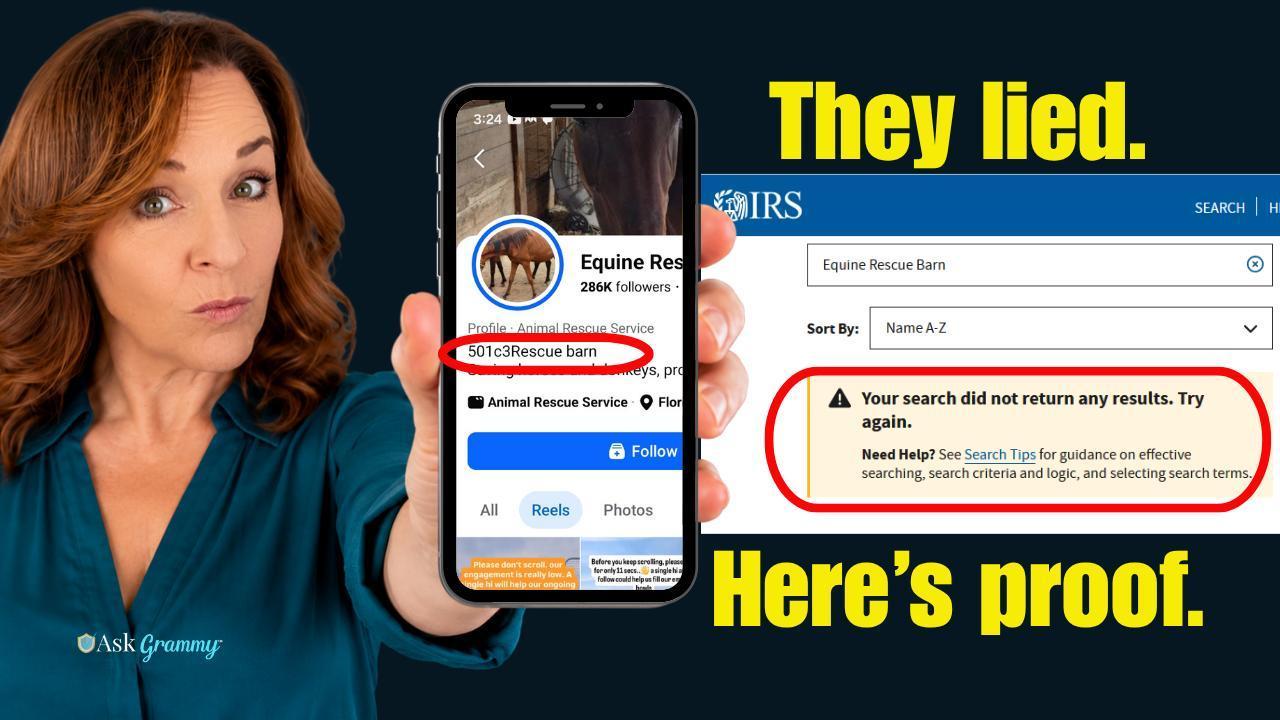
The first thing I do with any page claiming to be a nonprofit is go straight to the IRS. The Tax Exempt Organization Search is a free public database. If an organization is a legitimate 501(c)(3), they have to be registered, and that registration is public. You can search it yourself at apps.irs.gov/app/eos.
Here’s what the IRS had to say about the pages I looked into.
Equine Rescue Barn
Claims to be a 501(c)(3) nonprofit. The IRS has no record of this organization. Zero results.
Anne Ranch Horse Rescue
Same situation. Claims nonprofit status. Not listed with the IRS. Not a blip.
God’s Mercy Horse Rescue
Also claiming nonprofit status. Also not in the IRS database. And as we’ll see in a moment, their content is showing up recycled across multiple platforms under different names.
Second Chance Sanctuary
This one specifically claims to be a California-based 501(c)(3). When I searched the IRS database, four organizations came up with that name. None of them are in California. South Carolina, Connecticut, North Carolina, and New York. And the Connecticut one is on the Auto-Revocation List, meaning it had legitimate nonprofit status at one point and then lost it for failing to file required paperwork.
There is no California Second Chance Sanctuary registered with the IRS. The one collecting donations online doesn’t seem to exist as far as the federal government is concerned.
All Valley Horse Rescue – A Real Organization Being Exploited
Here’s where I want to be careful, because there IS a real All Valley Horse Rescue. All Valley Horse Rescue Inc. in Lancaster, California is a legitimate, IRS-registered 501(c)(3). EIN 35-2701304. It’s real.
The problem is that their content – actual videos of their actual horses – appears to be getting stolen and reposted by fake accounts on other platforms. The same video appears on a Second Chance Sanctuary YouTube account, a God’s Mercy Horse Rescue TikTok, and what appears to be an All Valley Horse Rescue YouTube channel. I have not been able to confirm that YouTube channel is actually operated by the real organization versus someone using their name.
That distinction matters. A real rescue is doing real work – and scammers are using their footage to collect donations that will never see the inside of a barn.
HopeHooves Rescue
HopeHooves is reposting content lifted directly from other accounts. I found a reel on their Facebook page that is identical to a TikTok posted by an account called Silent Hooves – two different names, same video.
Here’s the thing about that. If you’re running a real animal rescue, you have your own content. You’re there. You’re with the animals every day. You don’t need to borrow anyone else’s videos. If an account can’t produce original content from their own operation, there’s a reason for that.
Hungry & Abandoned Paws Shelter and Just One Life Shelter
These two appear to be separate Facebook pages. Different names, different profile pictures. But look a little closer and the story falls apart fast.
Same address: 1040 E Main St, Clarksville, Arkansas. Same boilerplate bio, word for word. Same photos, posted on the same date.
And then there are the language tells. The Hungry and Abandoned Paws page lists its language as ‘Ingles’ – the Spanish word for English. Someone set this page up with their interface in Spanish and didn’t catch that before publishing. The Just One Life address listing includes ‘EUA’ – the Portuguese and Spanish abbreviation for United States. Not how Americans write their own address. The contact email on the Hungry and Abandoned Paws page uses the word ‘atendimento’ – a Portuguese word meaning customer service.
Two Facebook pages. Almost certainly the same operator. Appearing to be based outside the United States. Using a copy-pasted American address. Collecting donations through a ko-fi link – a general crowdfunding platform, not a legitimate nonprofit giving tool.
Help Saving the Paws
This one stands out because of how fast it spun up. The website helpsavingthepaws.com was registered in January 2026. The Facebook page launched in December 2025. Brand new.
And already, the legitimate organization Saving Paws Animal Rescue has had to publicly clarify that they have no affiliation with this page, and that they don’t sell bracelets – a product this new operation was pushing. A real rescue is spending time and energy defending their reputation because someone launched a confusingly similar name to siphon off their goodwill. That’s the collateral damage of these operations.
How to Protect Yourself Before You Donate
The good news is that verifying a rescue organization isn’t hard. It takes about two minutes. Here’s what to do.
1. Check the IRS database
Go to apps.irs.gov/app/eos and search the organization name. If they claim to be a 501(c)(3) and they’re not in that database, you have your answer. If you want to be extra thorough, ask for their EIN – their Employer Identification Number – and search by that.
2. Reverse image or video search
Right-click any image or use Google Lens to search it. If that same photo or video is showing up across multiple accounts with different names, you’re looking at stolen content.
3. Look for the tells
Unusual abbreviations like EUA. Words like Ingles or Atendimento on a page claiming to be an American organization. Copy-pasted bios across multiple pages. Ko-fi links instead of proper nonprofit giving platforms. No physical address – or one that doesn’t check out.
4. Look for signs of legitimacy
Real rescues have an IRS registration. They have a local reputation you can verify. They post original content – real animals, real staff, real updates. Their financials are transparent. And they’re not running a brand new urgent deadline every single week.
Where to find real rescues
If you want to support animal rescue – and I absolutely hope you do – here are some trustworthy places to start:
Fake Animal Rescue Page Red Flag Checklist
Before you donate, run through this list. The more boxes that get checked, the more cautious you should be.
[ ] Claims 501(c)(3) status but has no IRS record
[ ] No EIN (Employer Identification Number) available
[ ] Posts recycled content from other accounts
[ ] Same videos or photos appearing under multiple page names
[ ] New page or website (less than one year old)
[ ] Constant urgent deadlines and dollar amounts
[ ] No original content showing real animals at their actual facility
[ ] Donation links go to ko-fi, Venmo, or PayPal personal accounts instead of a proper nonprofit platform
[ ] Language errors that suggest a non-English-speaking operator
[ ] Address that doesn’t check out
[ ] No verifiable physical location
[ ] No transparent financial reporting
The Bottom Line
The people who get scammed by these pages are some of the kindest people on the internet. They see a sad animal with a name and a deadline, and they open their hearts. That’s not stupidity. That’s humanity. And the scammers know exactly how to use it.
The best thing you can do is share this post – and the video – with someone in your circle who loves animals. Because I’d bet money at least one person you know has donated to a page like this.
And if you have a tip – something you want me to look into – drop it in the comments or reach out through AskGrammy.com. Lorin did, and look what happened.