
Summary
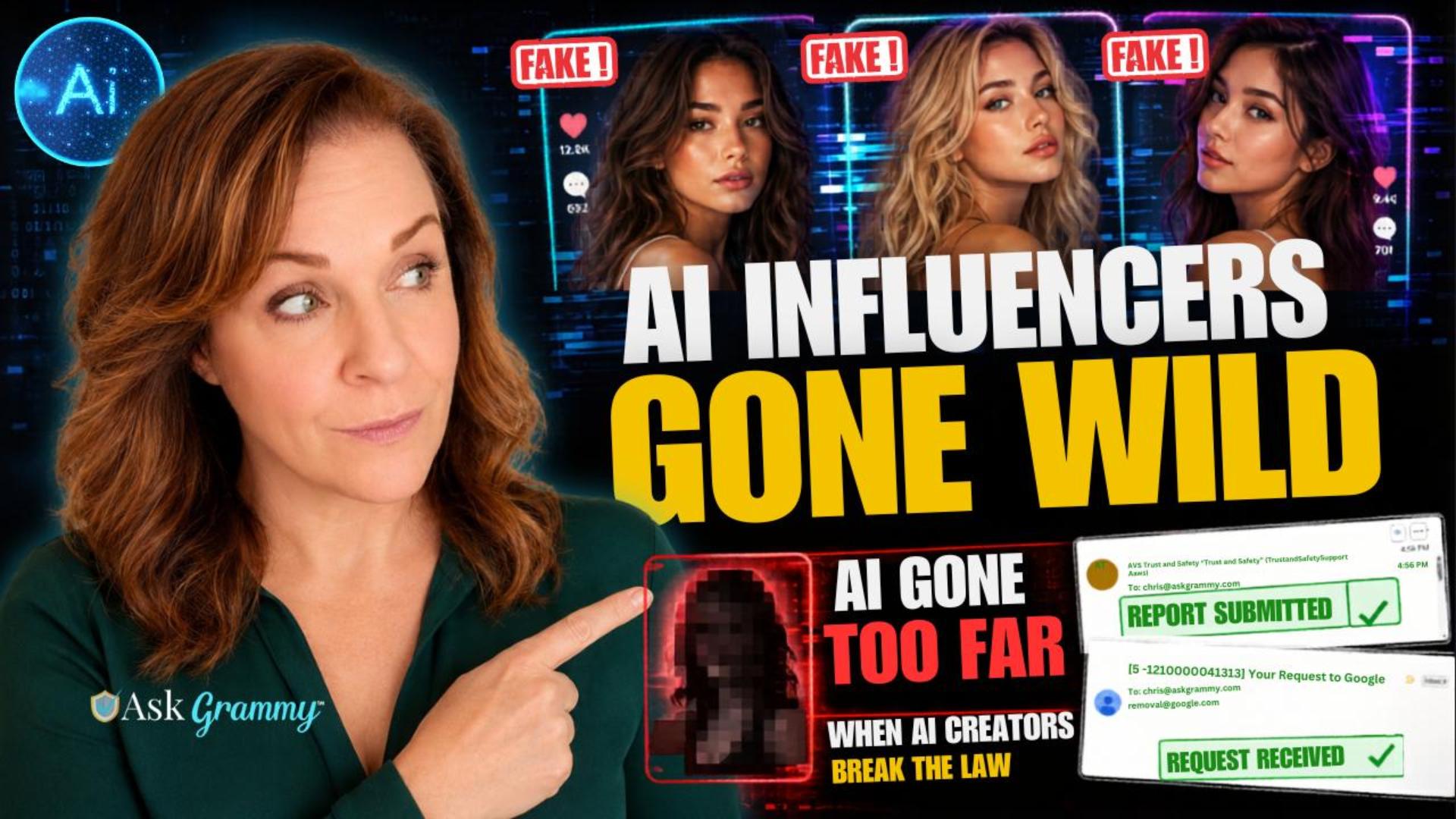
A deep-dive investigation into the world of AI-generated social media influencers - from legitimate virtual personas to predatory platforms to federally illegal content. Includes a firsthand account of reporting illegal AI-generated content to federal authorities, and a practical guide to protecting yourself and your family.
My research for this post started with a straightforward question: what exactly is an AI influencer, and should you be worried about them?
It ended with me filing a report with the National Center for Missing and Exploited Children and submitting a site takedown request to a web hosting company.
So. That escalated quickly.
The good news is that by the time you finish reading this, you’ll know exactly what AI influencers are, how to spot them, where the line between creative and criminal gets drawn, and what to do if you stumble onto something that crosses it. Because as I learned firsthand, that line is closer than most people think.
Watch the Full Investigation
I cover all of this in detail in the video below. If you’d rather read, keep scrolling – everything is here.
Prefer to read? The full breakdown continues below.
So What Exactly Is an AI Influencer?
At its most basic, an AI influencer is a social media personality that was created digitally rather than born. They post. They have followers. They promote products. They build audiences. They just don’t exist as human beings.
Some of them are animated characters. Some are hyper-realistic images of people who never lived. And some – the newest and most unsettling category – are digital replicas of real, living people.
The technology has been around longer than most people realize.
One of the earliest examples is a character called Nobody Sausage, a little animated dancing sausage from Brazil who started posting on TikTok in 2020 and picked up over 22 million followers. Nobody is trying to fool anyone there. It’s a cartoon sausage. That transparency is kind of the whole point.
Then there’s Lil Miquela, a CGI “19-year-old” who has been active on Instagram since 2016, has collaborated with brands like Prada and Calvin Klein, and has millions of followers worldwide. Her creators have never hidden what she is, and she became something of a cultural conversation piece about identity and authenticity in the digital age.
And there’s Lu of Magalu, who started as the mascot for a Brazilian retail chain back in 2003 and grew into the highest-earning virtual influencer on the planet, pulling in an estimated $2.5 million in sponsored posts in a single year.
These are legitimate, transparent, well-managed virtual personas. They exist, they’re successful, and there’s nothing inherently deceptive about them.
But that is not the whole story.
When “Creative” Becomes “Deceptive”
Here is where things start to get murky.
In the summer of 2025, an AI-generated influencer named Mia Zelu went viral for “attending” Wimbledon. She posted selfies from the stands. She had the outfits. She had the captions. She got thousands of genuine fan reactions from people who had no idea they were engaging with a computer-generated image.
She has 261,000 followers on Instagram. Not one pixel of her is real.
Researchers at Northeastern University studied this phenomenon and found something genuinely surprising: even when people are told an influencer is AI-generated, many of them keep engaging anyway. They know it’s fake and interact regardless. One professor compared it to the way we suspend disbelief at the movies, except now the “character” can respond to you in real time, remember your name, and make you feel seen.
That is a fascinating psychological wrinkle. It is also the foundation on which an entire predatory industry has been built.
The Money Behind the Fake Faces
Let’s talk about Aitana López.
Aitana is a pink-haired, 25-year-old fitness enthusiast and gamer with a growing Instagram following and a packed brand deal schedule. She was created by a Barcelona-based modeling agency called The Clueless, whose founder told reporters he built her because he was tired of working with real influencers who had, in his words, “egos and manias.”
She earns up to $11,000 a month. She can’t have a bad day. She can’t ask for a raise. She can’t quit.
And she has never drawn a single breath.
The agency uses Photoshop to create her images and built her “personality” around what their research suggested audiences respond to most. She is, essentially, a product engineered to be maximally likeable and minimally inconvenient.
Is that deceptive? That depends on how clearly the people engaging with her content understand what they’re looking at. And based on the comment sections on her posts, a meaningful number of them do not.
When Deception Becomes Manipulation: The OhChat Story
Now we move from murky to genuinely alarming.
A platform called OhChat describes itself as the “lovechild between OnlyFans and OpenAI.” That quote is real. Their CEO said it to CNN.
OhChat builds what they call “digital twins” of real celebrities – AI-powered replicas of living people that can interact with paying users around the clock. Last year, former British model Katie Price signed on. Her digital twin, named Jordan, can send voice notes, carry on extended conversations, and provide what the platform describes as “on-demand intimacy at scale.”
Katie Price is a consenting adult who made a deliberate business decision, and that’s her right. But researchers are raising serious concerns about what’s happening on the other side of that screen.
A senior research fellow at Cambridge University told CNN the platform creates “exactly the right environment for the human to be left behind completely – while still being exploited.” She was talking about the users. The paying customers. The people who may be forming genuine emotional attachments to an algorithm.
A legal expert told CNN that vulnerable fans risk becoming not just attached but addicted to these avatars.
OhChat has 200,000 users. Most of them are in the United States.
When an AI persona is specifically designed to build emotional connection and then monetize it, that is not creativity. That is manipulation dressed up in a chatbot.
Where I Had to Stop and Make Some Phone Calls
I need to tell you something that happened during my research for this post.
I was doing a standard Google search – looking for examples of AI-generated content on adult platforms – when the second search result led me to a page I was not prepared for.
The content I found was AI-generated imagery depicting individuals who were clearly designed to look like minors, presented in a sexual context. Not suggested. Not implied. Explicit.
I want to be clear about what this is under U.S. federal law. Under 18 U.S.C. § 2256, AI-generated sexual imagery depicting minors constitutes child sexual abuse material regardless of whether a real child was involved in its creation. The argument that “no real child was harmed” is not a legal defense. It is not a moral defense. It is not any kind of defense at all.
This content was not on the dark web. It was the second result on a standard Google search.
Here is what I did:
I filed a report with the National Center for Missing and Exploited Children via their CyberTipline. My report number is 240567106.
I submitted a content removal request directly to Google.
I contacted the web hosting provider by email, citing the relevant federal statutes and requesting immediate takedown and log preservation.
I contacted the domain registrar – Amazon Registrar – at their Trust and Safety address.
Within 24 hours of my report to the hosting provider, the page was gone. By the time Google arrived to process my removal request, a 404 error was already in place.
Reporting works. Please use it.
If you ever encounter content like this, go directly to missingkids.org/gethelpnow/cybertipline. You do not need to be an investigator. You do not need special knowledge. You just need to report it.
The DIY Industry Nobody’s Talking About
There is a subreddit called r/aiinfluencers that describes itself as a community for people who create, manage, and work with AI influencers. It is full of people building AI personas from scratch, specifically to deploy them on adult content platforms and monetize the emotional responses of real users.
There are YouTube channels dedicated entirely to tutorials on building virtual AI companions. There are communities sharing tips on making AI-generated personas more convincing, more responsive, and more effective at building the kind of parasocial attachment that keeps subscribers paying.
Some of the people using those platforms know exactly what they’re getting into. Some of them do not. And the ones who don’t are the ones I worry about.
How to Protect Yourself
Here is what I want you to walk away knowing.
AI influencers are real, they are everywhere, and they are not going away. Some of them are transparent creative projects. Some are corporate mascots. Some are legitimate business decisions by real people monetizing their likeness. That range exists, and not all of it is harmful.
You have the right to know when you are interacting with an AI. The FTC has guidelines requiring disclosure of paid partnerships from human influencers. The rules around AI personas are still catching up to the technology. That means right now, in this moment, it is largely on you to ask the question. Look for disclosure language in bios and captions. Search the name. Ask yourself whether the photos look quite right.
When an AI persona is designed to build emotional connection and then ask you for money, that is manipulation. It does not matter how real it feels. The feeling is the product.
If you find illegal content, report it. The CyberTipline at missingkids.org is where you go. You can also submit removal requests directly to Google. One person filing the right reports with the right information can get something removed from the internet in less than 24 hours. I know because it happened.
About This Investigation
This post is based on original research conducted by Grammy, consumer protection advocate and internet fraud investigator at AskGrammy.com. Sources include reporting from CNN, Business Insider, Euronews, and Northeastern University’s D’Amore-McKim School of Business, as well as direct observation and firsthand reporting activity including a verified report to the NCMEC CyberTipline (Report #240567106) and a confirmed content removal.
No illegal content was linked, described in detail, or reproduced in the creation of this post.
One More Thing
The internet is always going to be a few steps ahead of the rules. That is not new. What is new is how convincing “not real” has become.
The woman in the photo might not exist. The voice note might be an algorithm. The influencer recommending a product may have never touched it, thought about it, or breathed air.
Know what you’re looking at. Know who you’re talking to.
And when something feels off, trust that feeling. It exists for a reason.
Have questions about something you’ve seen online? Visit AskGrammy.com. Grammy reads every message.
SCAM / SAFETY CHECKLIST
How to Tell If an Influencer Might Be AI-Generated
- The photos look almost perfect – skin, lighting, and hair with no variation from post to post
- There are no candid or unflattering moments – ever
- Comments are enthusiastic but the replies feel slightly generic
- The bio doesn’t mention a hometown, family, or anything verifiably specific
- Reverse image search returns no results outside their own accounts
- The account promotes products but there are no behind-the-scenes moments
- When you search their name, there are no news articles, public records, or any trace outside social media
- Something just feels slightly off – trust that instinct
What To Do If You Find Illegal Content Online
- Do not share it, screenshot it, or send it to anyone
- Close the page
- Go to missingkids.org/gethelpnow/cybertipline and file a report
- Submit a removal request to Google at support.google.com
- Note the URL and the date so you can include it in your report