
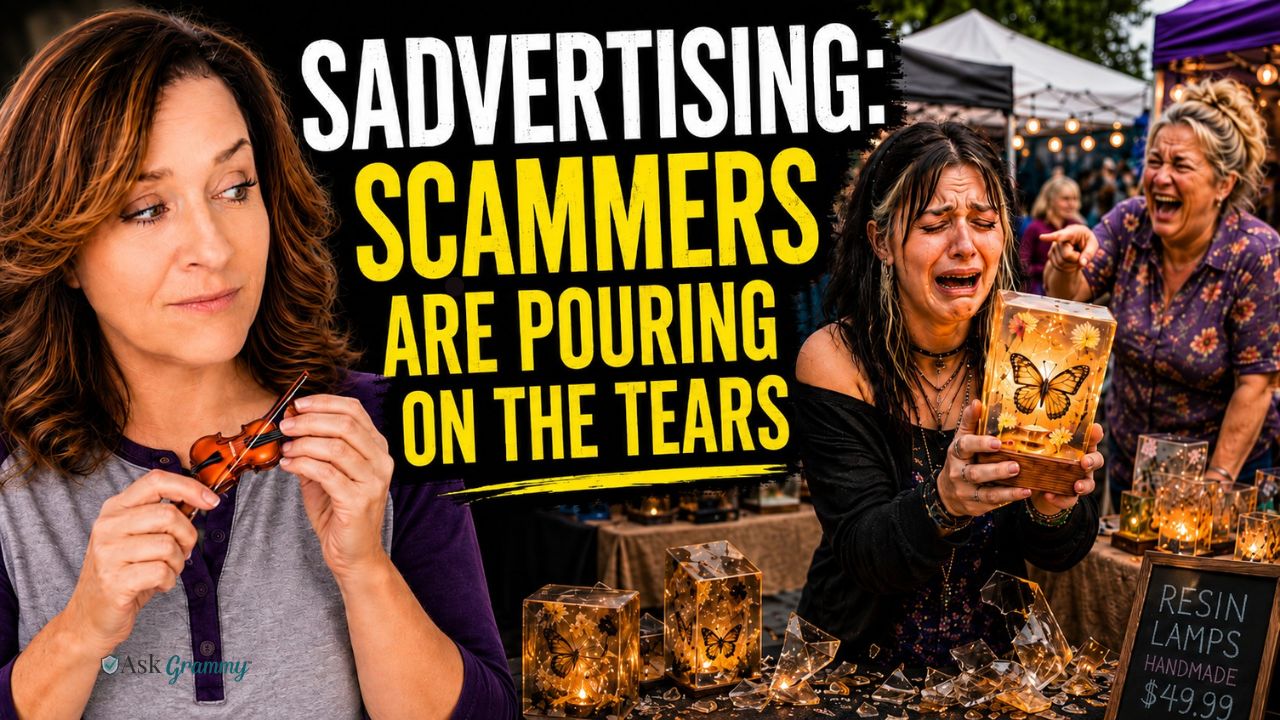
Summary
This post exposes a social media scam tactic called Sadvertising - the use of fake, AI-generated personas who cry, struggle, and beg for support in order to drive sales. Ten active pages are profiled, the manipulation formula is broken down, and readers are given six practical ways to protect themselves before buying.
You have probably seen it. A video pops up in your feed. A person (usually young, awkward, sweet and nervous) is holding up something they made. A crocheted cardigan. A resin lamp. A handmade bag. They worked so hard on it. They took it to a market. Nobody bought anything. Someone was cruel to them. And now they are in their car, or in their bedroom, barely holding it together.
The comments flood in. “You’ve got this, honey.” “Just ordered two.” “Sharing this everywhere.” Hundreds of thousands of them.
Here is what most of those commenters don’t know – in a lot of cases, that person does not exist.
What they’re watching is a carefully engineered manipulation tactic designed to bypass skepticism by overwhelming empathy. I call it Sadvertising. And it is one of the most effective scam formats running on Facebook, TikTok, and Instagram right now.
I have found ten pages using the exact same playbook – simultaneously, right now – and I want to walk you through every single one of them.
Prefer to read? Keep scrolling. Everything in the video is covered below.
About This Investigation
The pages profiled in this post were identified through social media monitoring and domain registration research conducted in May 2026. Domain registration dates were verified using public WHOIS records. This investigation is ongoing. Page names and domain registrations are documented as of the date of publication.
What Is Sadvertising?
Sadvertising is the name for a specific scam format that follows the same script almost every time.
A brand-new social media page appears. It features a sympathetic persona – usually young, often from a marginalized group, sometimes disabled, always relatable in some way. They post a video. They have a dream. They made a product. They took it to a craft fair or a market. Someone was horrible to them. Their work got mocked, dismissed, or thrown aside.
Then comes the crying video. Sometimes a supportive parent or sibling appears, pleading for kindness. A challenge goes out to a specific audience: “Can you stay ten seconds and tell them their work isn’t ugly?“
The comments explode. Orders come in. The scammers collect the money.
Before we go further, I want to be fair: emotional content exists in legitimate small business marketing too. Real makers have hard days. Real people post vulnerable content. Not every crying video is a scam. The difference is in the details, and that is exactly what we are going to look at.
This Is Not New – You May Have Seen It Before
Some of you may remember a video I did on a page selling resin lamps using Taylor Swift’s name and likeness, fronted by a sad, young woman whose lamps nobody would buy. That investigation got some traction, and for good reason.
That was the same playbook, and it’s not a one-off. It was one piece in a much larger network, and that network has been busy.
Ten Pages, One Playbook.
Here are the ten operations I identified, all active as of May 2026. Pay attention to the domain registration dates. These are not established small businesses. They’re brand-new operations wearing a handmade-artisan costume.
WyrmCraft
Domain registered: February 25, 2026. Selling cutting boards. Persona: young woman.
Moonbound Works (also known as Redmont)
Domain registered: March 15, 2026. Selling berry washing bowls. Persona: young man described in their own content as a “fat ginger kid.”
Upside Down Lamps Co
Domain registered: March 10, 2026. Selling lobster handbags. Persona: middle-aged woman. This page has operated under several different names and has cycled through multiple products and personas over time.
Nora’s Wallets
- Domain registered: April 2, 2026. Selling bat-shaped bags. Persona: young goth woman.
Threaded Wings
- Domain registered: April 19, 2026. Selling crocheted butterfly cardigans. Persona: young man presented as autistic.
Jacks Lamps
- Domain registered: April 11, 2026. Selling resin anime lamps. Persona: bearded middle-aged man. Previously investigated in connection with Taylor Swift likeness use.
Sam Byler
- Domain registered: April 23, 2026. Selling resin lamps. Persona: young man with Down syndrome.
Nora’s Threads
- Domain registered: April 26, 2026. Selling berry washing bowls, butterfly cardigans, herb strippers, and blankets — all at once, from the same supposedly passionate young artisan. Persona: young man. This page has also operated as VeraCrafts.
Veronica’s Crochets (also known as VeraCrafts)
- Domain registered: May 8, 2026. Selling butterfly cardigans. Persona: young woman.
Caden Crafts (also known as VeraCrafts)
- Domain registered: May 19, 2026. Selling resin horror lamps. Persona: young goth man. Also previously operated under the VeraCrafts name.
That is ten pages. Multiple overlapping identities. A dizzying rotation of products, personas, and page names — all running the same emotional manipulation formula at the same time.
Meet the AI Dad
Running a scam farm at this scale requires content, and lots of it. Every sympathetic main character needs a supporting cast. And apparently, a lot of these struggling young makers share the same father.
A man in a safety vest and jeans appears as a supportive parent figure across multiple pages in this network. Same man. Different child every time. When you run his image through Google’s reverse image search, he turns up vouching for the butterfly cardigan kid, the horror lamp guy, and likely a few others we have not found yet.
One AI dad. Unlimited children. Unlimited sympathy.
There is also a detail worth noting about several of the younger personas: a surprising number of them feature videos of themselves working at Starbucks. It is a calculated visual shorthand – just a regular, hardworking young person in an apron, doing their best. It is not accidental. It is casting.
The Most Disturbing Part: Using Disability as a Sales Tool
Two of these ten pages feature personas with disabilities. Threaded Wings presents as an autistic young man. Sam Byler presents as a young man with Down syndrome.
I want to say something directly about this, because it deserves more than a passing mention.
Real disabled people – real autistic people, real people with Down syndrome – work every day to be seen as capable, independent, and worthy of respect on their own terms. They push back constantly against pity, against condescension, against being treated as objects of charity rather than full human beings.
And then a faceless content farm decides that disability is a useful sales lever. That generating a fake disabled persona and making them cry on camera is a smart marketing strategy.
If you were moved by those videos, that is not a flaw in you. That is your humanity working exactly as it should. The flaw belongs entirely to the people who decided to exploit it.
The Scripts They All Use
One of the clearest signs that these operations are coordinated is the language. These are real lines pulled directly from these pages:
“I truly trust goth girlies to stay 12 seconds to tell me my wallets aren’t ugly.”
“Even as a black woman, I have more faith that white women will stay 12 seconds to save my lobster bag business.”
Notice what is happening. They are not just asking for sympathy. They are issuing an identity-based challenge. Prove you are who you think you are by spending twelve seconds on this. It is engineered to make scrolling past feel like a moral failure.
It works. The comment counts on these posts are in the hundreds of thousands. That is not organic community. That is a machine running a tested script.
How to Protect Yourself
Six Things to Check Before You Buy From an Emotional Social Media Post
- Check the domain registration date. Go to whois.com and type the website address attached to the online store (be sure to use the form field with the “WHOIS” button). If that passionate small business launched just a few weeks ago, that tells you something important.
- Look at what else they are selling. Real makers have a focus. A page selling berry washing bowls, butterfly cardigans, herb strippers, and blankets all at once is not a passionate artisan. It is a storefront.
- Run a reverse image search on the persona. Right-click their photo, or take a screenshot and upload it to Google Images. If that face appears across multiple unrelated pages, they are not a real person.
- Watch for the family support video. A parent or sibling appearing to vouch for the struggling young maker is a standard element of this format. Ask yourself when you last saw a legitimate small business owner’s parent post a video begging strangers to be kind.
- Read the comments carefully. High comment counts are not the same as real engagement. Generic, emotionally similar comments with very little specific product feedback are a flag.
- Slow down before you click buy. The entire point of Sadvertising is to overwhelm your skepticism with urgency and emotion. Thirty seconds of pause is all the protection you need.
Share This. Seriously.
The best thing about Sadvertising – from the scammer’s perspective – is that it works on kind people. People who want to help. People who believe in rooting for the underdog. Those are good instincts, and no one should be ashamed of having them.
But kind people deserve to know when their kindness is being weaponized against them. That is what this is for.
Share this post. Tag someone who you think might need it. And if you want more investigations like this one, you know where to find me.
Have you seen a page that looks like it fits this pattern? Tell me about it in the comments. I read everything, and the next investigation might start with something you spotted.